
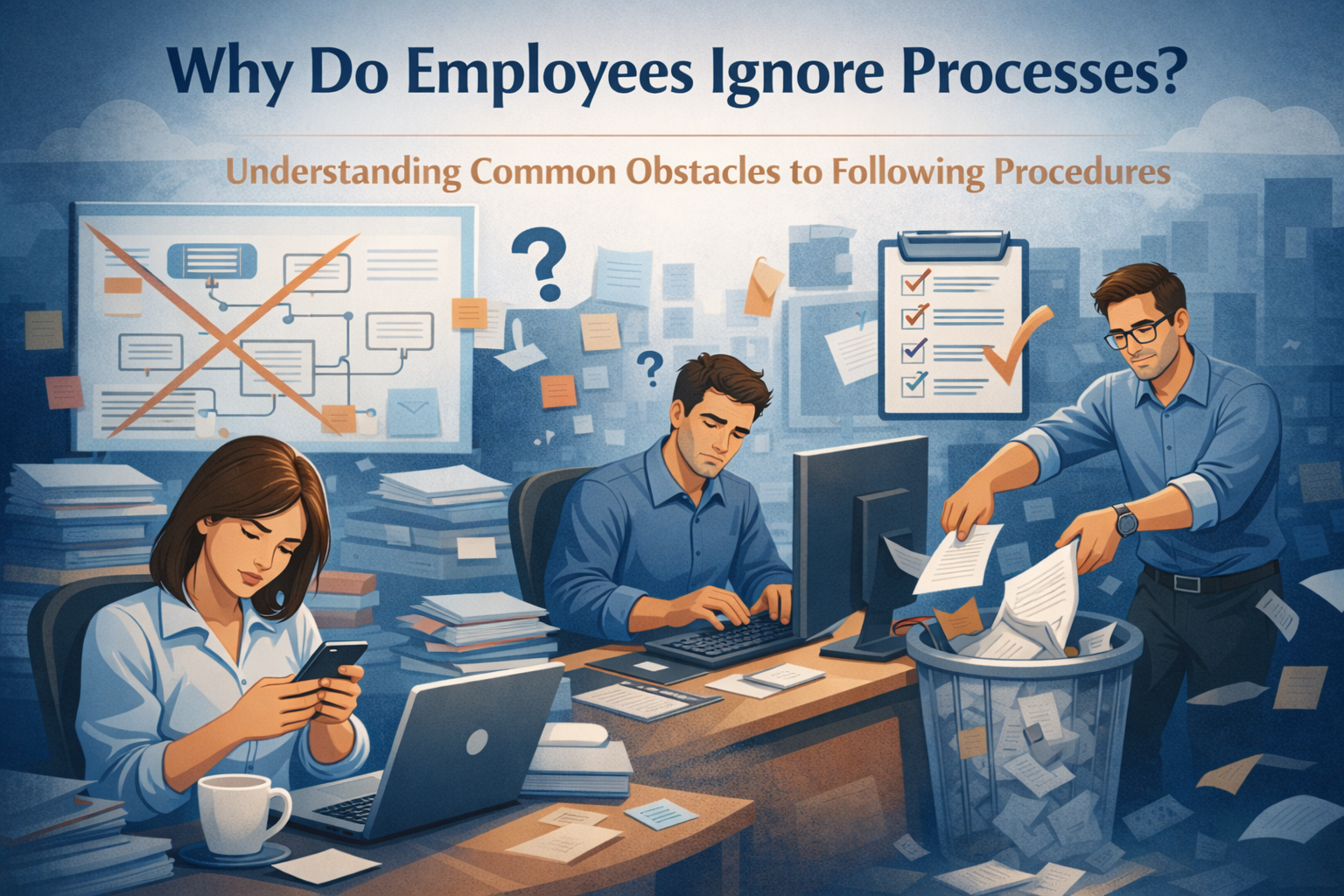
Why Do Employees Ignore Processes?
Even when leaders put real effort into procedures, teams often drift away from them. Here’s why that happens and how to build processes employees actually follow.
Many business owners put real effort into creating processes.
Introduction
Many business owners eventually ask that question.
They write procedures, create checklists, hold meetings, and explain how work should be done. But after a short time, something frustrating happens.
Employees begin ignoring the process.
They skip steps. They do things their own way. They ask questions that the process was supposed to answer.
It can feel like a discipline problem or a lack of accountability. But in most cases, the issue runs deeper than that.
Employees usually ignore processes for a few predictable reasons. Understanding those reasons is the first step toward building processes that people actually use.
This is often closely related to the same operational friction discussed in our article on why a business can feel disorganized during growth.
Many Processes Are Created Without Employee Input
One of the most common reasons processes fail is simple:
Employees were never involved in creating them.
When leaders design processes on their own, they often make logical decisions based on what they believe should work. But employees doing the work every day may see the situation differently.
They may know:
- Where the real bottlenecks are
- Which steps slow things down
- What customers actually need
- What tools or information are missing
If employees feel that a process was imposed on them without their input, they are less likely to feel ownership of it.
Instead of viewing the process as something helpful, they may see it as something they are forced to follow.
When people feel disconnected from the process, they often default back to the methods they already trust.
Involving employees in process development does something powerful: it creates investment.
When people help build the system, they are much more likely to support it.
Employees Don’t See the Purpose
Another major reason employees ignore processes is that they don’t understand why the process exists.
To a leader, a process may serve an important purpose:
- Preventing mistakes
- Protecting quality
- Improving communication
- Ensuring consistency
But if employees only see the process as extra steps, they may view it as unnecessary work.
For example:
A team might be required to complete documentation after finishing a job. From leadership’s perspective, this documentation helps track performance and prevent future errors.
But if employees are never told this, they may see it as pointless paperwork.
Without understanding the purpose, people naturally begin asking themselves:
If the answer is unclear, the step is often skipped.
Good processes explain not only what to do, but why it matters.
The Process Is Too Complicated
Sometimes employees ignore processes because they are simply too complicated to follow consistently.
This often happens when organizations try to document every detail of a workflow.
The result can be:
- Long procedure manuals
- Multi-step approval systems
- Complex forms
- Overly detailed instructions
While these systems may be designed with good intentions, they often slow down real work.
When a process becomes too heavy, employees look for shortcuts so they can complete their tasks efficiently.
In many cases, this behavior is not laziness—it is a reaction to unnecessary complexity.
The best processes are usually the simplest ones.
They clarify the essential steps required for quality work without creating unnecessary barriers.
The Process Doesn’t Match Real Work
Another reason processes fail is that they were created without fully understanding how work actually happens.
Over time, employees develop ways of handling tasks that fit the real conditions of the job. They learn how to solve problems quickly and adapt to unexpected situations.
If a formal process does not reflect that reality, employees may find that following it slows them down or creates new problems.
For example:
A process may require approvals from multiple departments, but employees know that those approvals rarely change anything.
So they skip the step and move forward.
From management’s perspective, the process is being ignored. From the employee’s perspective, they are simply doing what allows the work to continue.
Processes must be aligned with real workflows, not idealized ones.
Accountability Is Unclear
Even when processes are well designed, they can break down if no one is responsible for enforcing them.
Employees naturally pay attention to the behaviors that leaders monitor and reinforce.
If a process exists on paper but:
- No one checks whether it is followed
- Mistakes are ignored
- Leaders bypass the process themselves
Then the process slowly loses credibility.
Over time employees learn that the process is optional.
Clear accountability does not require harsh enforcement. It simply requires consistency.
When leaders demonstrate that processes matter—and follow them themselves—teams are far more likely to adopt them.
Employees Need the Right Tools
Processes also fail when employees lack the tools needed to follow them effectively.
For example:
A process may require employees to log information into a system. But if the system is slow, confusing, or difficult to access, employees may avoid it.
Similarly, a process may require coordination between teams, but communication tools may not support that collaboration.
In these situations, ignoring the process becomes the easiest way to get work done.
Good processes always consider the practical tools available to employees.
If the system makes the work harder instead of easier, adoption will always be limited.
That is one reason many organizations evaluate operational platforms and workflow tools through resources like workforce management software reviews when they are trying to improve adoption and consistency.
Culture Influences Whether Processes Are Followed
Finally, processes succeed or fail depending on the organization’s culture.
In some companies, processes are seen as valuable tools that support consistency and teamwork.
In others, they are viewed as bureaucratic obstacles that slow people down.
Culture is shaped by leadership behavior.
If leaders treat processes as flexible suggestions, employees will do the same.
But when leaders explain the purpose of processes, involve employees in improving them, and model the behaviors they expect, processes become part of the organization’s normal way of working.
How to Create Processes Employees Will Follow
If employees are ignoring processes in your organization, the solution is not simply adding more rules.
Instead, focus on building processes that people understand, trust, and value.
Here are several practical ways to improve adoption.
Involve Employees in Designing Processes
People closest to the work often understand it best.
When employees contribute to building processes, they help identify practical steps that actually work in real situations.
This involvement also creates ownership.
Explain the Purpose Behind the Process
Employees are far more likely to follow a process when they understand how it helps the organization succeed.
Explain how the process improves:
- Quality
- Efficiency
- Customer experience
- Teamwork
When people see the bigger picture, processes feel more meaningful.
Simplify Whenever Possible
If a process feels heavy or complicated, it may need to be simplified.
Focus on the critical steps that truly matter rather than documenting every possible detail.
Clear and practical processes are much easier to follow consistently.
Align Processes With Real Workflows
Before finalizing a process, observe how the work is actually performed.
Talk with employees who complete the tasks daily. Identify where the process fits naturally into their workflow.
Processes that match real work patterns are far more sustainable.
Reinforce the Process Consistently
Leaders set the tone for how processes are treated.
When leaders follow the same procedures and reinforce them consistently, employees quickly recognize that the process is important.
Consistency builds trust in the system.
A Final Thought
When employees ignore processes, it is rarely because they are unwilling to do their jobs well.
More often, the process lacks clarity, relevance, or connection to the people doing the work.
At AnchorFlow, we often help organizations identify where processes have become disconnected from real workflows. By involving employees, simplifying systems, and clarifying the purpose behind key procedures, businesses can build processes that teams actually follow—and that support smoother, more effective operations.
Ready to build processes your team will actually use?
AnchorFlow helps growing companies simplify workflows, improve adoption, and create practical systems that support stronger operations.
Talk with AnchorFlow