

From Paperwork to Partnership: The Job Evaluation That Builds Success Together
Most companies treat evaluations like a checkbox. Here’s why that’s costing them their best people — and what to do instead.
Joe had been with the company for about a year when he finally got up the courage to ask.
He walked into his manager’s office and said, “Hey Bill, do we do job evaluations here? I haven’t seen anything like that since I started.”
Bill leaned back and didn’t hesitate. “Joe,” he said, “we’re all old enough here. If someone needs a job evaluation, they probably shouldn’t be working here.”
Joe nodded, said “Got it,” and walked out.
On the surface, it sounds reasonable. Most business owners want self-driven people who take initiative. But here’s what Bill missed — and what a lot of leaders miss: even the most capable, mature employees still need clarity. They need to know what success looks like, where they stand, and how they can grow. Without that, you don’t get independence. You get inconsistency.
Navigate This Article
Use the guide below to jump directly to each major section.
The Problem with Treating Evaluations Like Paperwork
Most companies check the box. They rush through an annual review, hand the employee a form, and move on. But a job evaluation was never meant to be a form — it was meant to be a conversation.
When evaluations are rushed or skipped entirely, employees are left guessing. They may work hard, but they don’t know where they truly stand. They don’t know what they do well, what needs to change, or how leadership actually perceives them. Without that feedback, growth stalls — not because people don’t care, but because no one has clearly shown them the path forward.
Start with Commendation — Before Anything Else
Before the first category is reviewed, before a single rating is discussed, a strong evaluation begins with genuine commendation. Not a quick “good job” to get through it — but a real, specific acknowledgment of who this person is and what they bring to the team.
This is the moment a leader says: I see you. I notice what you do. And I want you to know it matters.
It might sound like this: “Before we get into the evaluation, I want to take a minute to tell you what I genuinely appreciate about having you on this team. The way you handle difficult customers without losing your composure — that’s not easy, and it doesn’t go unnoticed. I also want you to know that your dependability has made my job easier in ways I don’t say enough.”
This isn’t flattery. It’s leadership. When an employee feels genuinely seen before the conversation begins, they are far more open to honest feedback, more willing to hear what needs to improve, and more invested in the outcome. Commendation is not a warm-up — it’s a foundation.
Explaining the Rating System — Before You Use It
One of the most overlooked moments in any evaluation is this: explaining what the ratings actually mean before the employee receives them. Most leaders skip this. They hand over a form with numbers and assume everyone understands. They don’t.
A rating system only works when both people in the room understand it the same way. Before reviewing any category, take a moment to walk the employee through the scale — clearly, simply, and without rushing. Here’s how to frame it:
HOW TO EXPLAIN THE SCALE TO YOUR EMPLOYEE
“I want to take a minute to walk you through how this rating system works before we get into it — because I want these ratings to mean something to you, not just be numbers on a page. Satisfactory means you are doing the job you were hired to do. That is a good rating. That means you are meeting expectations, and you should feel good about that. Not everyone does. Above Satisfactory means you are going beyond what is expected in this area. And Excels — that one is reserved for something that truly stands out. It means you are exceptional in this area, not just good. On the other side, Needs Improvement means this is an area we are going to work on together — and I mean together. And Not Meeting Expectations means we have a gap that needs immediate attention. I’ll always give you a clear plan if we land there. Any questions before we start?”
That conversation takes two minutes. It prevents misunderstanding, removes anxiety, and sets the right tone before a single rating is given.
What the Ratings Actually Mean
Here is the full framework, written plainly:
| RATING | WHAT IT MEANS | WHAT TO SAY |
|---|---|---|
| EXCELS | A standout strength — consistently goes far beyond expectations | "This is one of the things that makes you truly valuable here." |
| ABOVE SATISFACTORY | Performing better than what is typically expected in this role | "You're going beyond what we ask — keep building on this." |
| SATISFACTORY ✓ | Meeting the full expectations of the role — this is a good rating | "You are doing the job you were hired to do." |
| NEEDS IMPROVEMENT | An area we need to work on together — with a plan | "Here's what I want us to work on, and here's how I'll support you." |
| NOT MEETING EXPECTATIONS | Performance is falling short and needs immediate, focused attention | "This needs to change, and here is the specific plan we're going to follow." |
Satisfactory is worth repeating: it means the employee is fulfilling the role they were hired for. That is not a mediocre outcome — that is the standard. An employee who receives all Satisfactory ratings has done their job well. They should walk out of that evaluation feeling capable and clear, not deflated.
One more thing worth saying: you do not have to use the exact word “Satisfactory.” What matters far more than the word itself is that the word you choose clearly communicates the right message — that this person is doing their job, they are meeting the mark, and you are good with them. Words like “Job Met,” “Solid Performance,” “Meets Expectations,” or “On Track” all carry that same meaning with dignity. Whatever language fits your company’s culture, use it — as long as the employee walks away knowing that rating is something to feel good about, not something to feel ashamed of.
How to Correct Someone Without Losing Them
Tone changes everything. When feedback is handled poorly, it feels like judgment. When it’s handled well, it feels like investment.
Instead of pointing out what is wrong, a strong evaluation focuses on what can be improved — and how both sides will work toward that together. Employees begin to share what they’re experiencing, what challenges they’re facing, and where they need support. Often the real issue isn’t effort — it’s unclear expectations or a gap that has simply never been discussed.
Every area below standard should include three things: the employee’s perspective on the challenge, a clear and specific plan of action, and a commitment of support from leadership. Without those three, the evaluation becomes criticism. With them, it becomes a turning point.
There’s a moment in every strong evaluation when the employee asks, “What do I need to do to improve?” That question is the signal. At that moment, the relationship shifts from correction to growth.
Don’t Stop at Performance — Talk About the Future
Most evaluations stop too soon. They review performance and end. But one of the most powerful parts of any evaluation is what comes next: a genuine conversation about where the employee wants to go.
- Where do they want to grow within the company?
- What skills do they want to develop?
- How do they see their future here?
- How can they become more valuable — and feel more fulfilled?
This is where the relationship deepens. The employee stops feeling evaluated and starts feeling invested in. Leadership gains clarity on how to develop them. And the evaluation stops being about accountability and becomes a tool for development.
Why a Downloaded Template Won’t Fix This
Many companies try to shortcut the process with a generic evaluation template. It feels efficient — but it misses the point entirely. An effective evaluation must reflect your company’s mission, your values, and what success actually looks like in your environment. What you measure communicates what you value. If your evaluation doesn’t reflect your culture, it won’t produce the behavior you want.
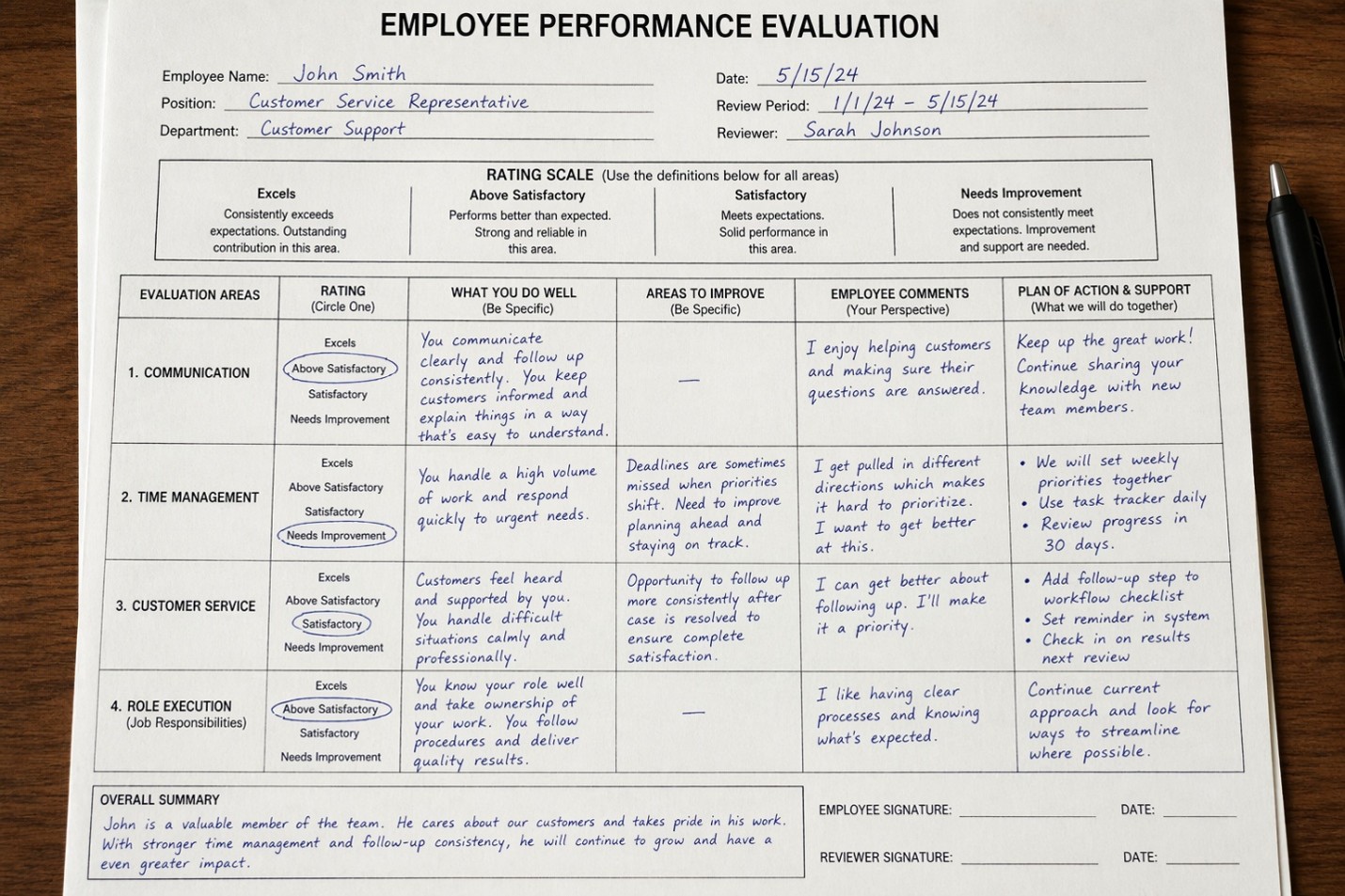
Below is a sample evaluation to illustrate what this looks like in practice. Every company will need to build one that reflects their own culture and values — but as you look at this example, notice a few things: the employee's strengths are named specifically, not generally. There is space for the employee to share their own perspective. And every area that needs improvement includes a clear plan and a commitment from the supervisor to help get there.
That is what separates an evaluation that builds trust from one that simply delivers a verdict.
What a Strong Evaluation Looks Like: A Quick Reference
Quick Reference
-
START WITH COMMENDATION
Before the first rating is discussed, genuinely acknowledge who this person is and what they bring to the team. This is not a warm-up — it is a foundation. When an employee feels seen, they become far more open to everything that follows. -
EXPLAIN THE RATING SYSTEM FIRST
Walk the employee through what each rating actually means before using it. Satisfactory is a good rating — it means they are doing the job they were hired to do. Make sure they know that before a single number is given. -
BE SPECIFIC ABOUT STRENGTHS
Vague praise does not help anyone grow. Name exactly what the employee does well and why it matters. If they cannot hear specifically what to repeat, they cannot build on it. -
PAIR EVERY AREA OF IMPROVEMENT WITH A PLAN
Every area below standard needs three things: the employee’s perspective, a clear plan of action, and your commitment to support them. Without all three, feedback becomes criticism. With them, it becomes a turning point. -
WATCH YOUR TONE
When handled poorly, feedback feels like judgment. When handled well, it feels like investment. The difference is almost always tone. Focus on what can be improved and how you will work toward it together — not on what went wrong. -
TALK ABOUT THE FUTURE
Do not stop at performance. Ask where the employee wants to grow, what skills they want to develop, and how they see their future with the company. This is where the relationship deepens and the evaluation becomes a tool for development, not just accountability. -
BUILD YOUR OWN SYSTEM — DON’T DOWNLOAD SOMEONE ELSE’S
What you measure communicates what you value. A generic template will not reflect your mission, your culture, or what success actually looks like in your company. Build something that does.
Yes, This Takes Time. Here’s Why It’s Worth Every Minute.
Some leaders will read through this process and think: this is a lot. And they are right — it is more than most companies do. Done well, a thorough evaluation takes real preparation, real attention, and real time. It would be dishonest to say otherwise.
But before you decide it is too much, ask yourself one question: what is your most important asset as a leader?
It is not your strategy. It is not your systems. It is not even your product. It is your people. When your people are motivated, engaged, and feel genuinely valued — they work hard for you. Not because they have to. Because they want to. Because they believe you are on their side. And that belief is not built through a paycheck. It is built through moments like this one, when a leader sits down, looks someone in the eye, and says: I see you, I will be honest with you, and I am invested in where you are going.
— Simon Sinek
A job evaluation done right is not a performance review. It is a relationship. It is a tool for motivation, development, and trust. It is how a leader says, without using those exact words: you matter here, and I am not going to let you stay stuck. That is what turns a good employee into a committed one — and a committed team into something that is very hard to compete with.
Anyone can manage people. A true leader develops them. And this process — done with intention, honesty, and genuine care — is one of the clearest expressions of what real leadership looks like.
What separates leaders who build teams from those who just manage them?
Anyone can fill out a form. Far fewer know how to use an evaluation to create clarity, build trust, and guide real growth. When evaluations are done poorly, they feel like judgment. When they’re done well, they feel like the best conversation an employee has had all year.
At AnchorFlow, we don’t hand you templates and walk away.
We work with you — directly and practically — to build evaluation systems that are customized to your company, your culture, and your team. That means helping you design the evaluation itself. It means sitting with your directors and managers to help them actually lead these conversations well. And it means staying involved as you put it into practice, not disappearing after the delivery. Most consultants drop off a framework and move on. That is not what we do. We believe the most valuable thing we can offer is not a document — it is the skill, the confidence, and the ongoing partnership to use it well.
Ready to build something your team will actually benefit from — and have a partner who stays with you to make sure it works? Contact AnchorFlow to get started.
Let's Build a Better Evaluation Process