
⏱ Estimated Read Time: 9–11 minutes
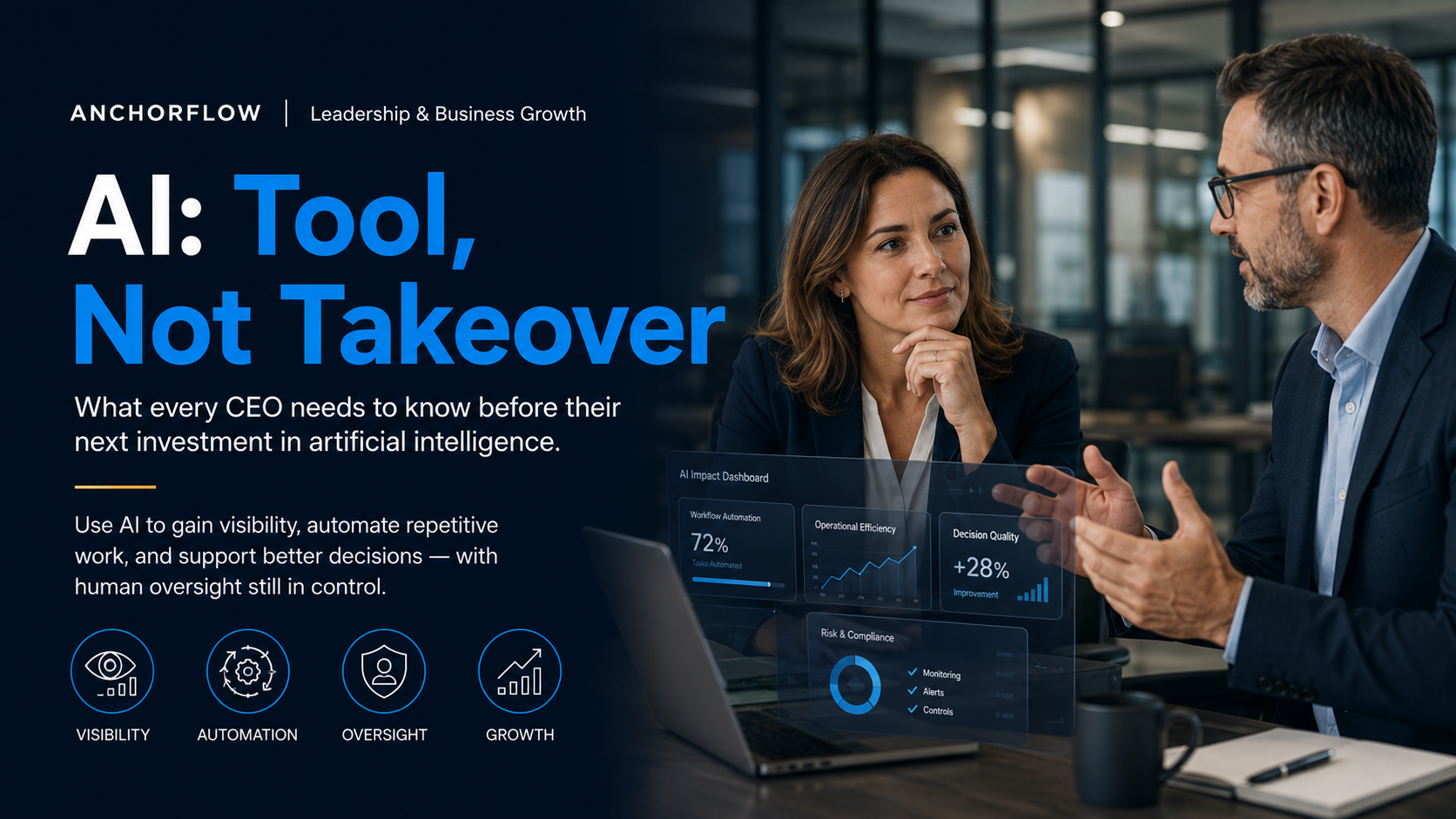
AI: Tool, Not Takeover
What Every CEO Needs to Know Before Their Next Investment in Artificial Intelligence
Some people say AI is going to end civilization. Others say it will usher in the greatest era in human history. The truth? It’s a tool. And like any tool, what matters most is who is holding it — and whether they know how to use it.
Navigate This Article
Use the guide below to jump directly to each major section.
The CEO Who Couldn’t Sleep
It’s 2 a.m. and you are staring at the ceiling. You’re wondering if that invoice went out. You’re not sure if the project your team promised is actually on track. You have no idea whether the new client was followed up with — or whether that fell through the cracks again.
You’re not a bad leader. You’re just flying blind.
You have a team of good people. But you can’t be everywhere at once. And the information you need to run your company well is buried in emails, spreadsheets, and the memories of your employees — none of which you can see at 2 a.m.
This is exactly the problem AI and automation are built to solve.
If this sounds familiar, the technology problem may actually be part of a larger organizational problem. We explored that issue in Why Does My Business Feel So Disorganized? — because technology works best after leadership understands where information, ownership, and accountability are breaking down.
What Is AI, Really?
Let’s cut through the noise. Pick up any newspaper and you’ll find two camps. One side says AI is going to destroy jobs, end privacy, and eventually outsmart all of humanity. The other side says we’re on the edge of a golden age where disease gets cured, poverty ends, and every business runs at peak efficiency.
Neither extreme is very useful to you as a CEO trying to run a company in the real world.
Here is the honest, balanced view: AI is a tool. A remarkably powerful one — but a tool nonetheless. A hammer doesn’t build a house. A person with a plan builds a house. The hammer just makes it faster and more precise. AI works the same way.
What makes AI genuinely different from other tools is speed and scale. It can compile in minutes what would take a human team days. It can spot patterns across thousands of data points that no single person could hold in their head.
And yes — in some areas, it already knows more than any one person does. But it still needs a human to ask the right questions and decide what to do with the answers.
By the Numbers
of CEOs say AI has delivered real cost and revenue benefits,
while 30% report some revenue uplift.
PwC 29th Global CEO Survey, 2026
of CEOs say AI will force an overhaul of how their company
operates.
Gartner CEO Survey, April 2026
of U.S. workers say they are worried about the future impact
of AI on their jobs.
Pew Research Center, 2025
of workers have had to fix work that relied too heavily on
AI without human oversight.
Founder Reports, AI in the Workplace 2026
AI can process more information than you can. It cannot replace your responsibility to decide what that information means for your company.
How Could a Service Provider Use AI As One of Their Tools to Help Your Company?
Here is a real example of what automation looks like in practice. Imagine you could open a single webpage every morning that showed you:
All of it. In one place. Updated in real time.
That dashboard can be built today. It connects to your accounting system, your CRM, your project management tools — and it gives you a snapshot of your entire company at a glance.
Now, you might be thinking: “My CRM already gives me a dashboard.” Fair point. But most software dashboards only show you what is happening inside that one system.
This is different.
This pulls data from every system you use — accounting, CRM, project management, timecards — and puts it all in one place.
But it doesn’t stop at showing you numbers on a screen. This is like having a sharp analyst sitting inside all of that data, around the clock, looking for the patterns you would never catch on your own.
It can spot correlations between what is happening in your invoices and what is happening on your projects. It can flag a trend forming before it becomes a problem. It can tell you what to expect over the next few months based on what is actually happening right now.
Instead of logging into three different platforms and doing the math yourself, you get the whole picture — and the patterns hiding inside it.
What About the Repetitive Stuff?
Think about the tasks in your company that happen the same way every single time.
Sending invoice reminders. Routing new leads to the right salesperson. Scheduling follow-up emails. Answering the same five questions customers ask every day.
These tasks don’t require creativity. They require consistency. And AI is exceptionally good at consistency — it never forgets, never has a bad day, and never puts something off until Monday.
The goal is not to automate everything people do. The goal is to stop making talented people spend their day doing work that never required their talent in the first place.
When you automate those repetitive tasks, something important happens: your people get their time back.
They can focus on the work that actually requires a human — building relationships, solving complex problems, making judgment calls, and growing the business.
The Conversation You’re Going to Have to Have
Here is something you need to be prepared for as a CEO. The moment your team hears the word “AI,” someone in that room is going to think:
That fear is real. According to a Pew Research survey, 52% of U.S. workers say they are worried about the future impact of AI on their jobs.
You can’t ignore that.
If you try to roll out AI without addressing it directly, you will run into resistance — quiet resistance, the kind where people slow-walk new systems and find reasons why things “aren’t working.”
The answer is not to hide what you are doing. The answer is to be honest about what you are building — and why.
A receptionist whose phones get handled by an AI agent is not necessarily losing her job. She may be gaining a better one — one where she becomes the face of the company, where she manages the dashboard and brings you the insights that matter, where she does work that actually uses her skills instead of picking up the same calls all day.
But she won’t believe that unless you tell her — clearly, specifically, and early.
The fear of AI is real. The answer is not to hide what you are building — it is to be honest about why you are building it and what it means for your people.
Find Your Champions
In every company, there is at least one person who gets it.
They are curious. They have already been quietly experimenting with AI tools on their own. They see the potential. They are not afraid — they are excited.
That person is your champion.
And they may be the most important person in your AI rollout.
When you identify the people in your company who want to see AI work — who believe in it and are willing to help others get comfortable with it — you have an internal advocate that no outside consultant can replace.
Finding them, and using them well, is not something most CEOs have time to figure out on their own.
That is part of what AnchorFlow does with you — we help you spot your champions, and we help the message land as one from a trusted colleague, not a vendor or a mandate from above.
A Note on Supervision: AI Is Not “Set It and Forget It”
One more thing every CEO needs to hear: AI needs to be supervised. Not micromanaged. But watched.
A well-built automation dashboard is not something you plug in once and walk away from. It needs to be checked. Outputs need to be reviewed. Someone needs to own it.
That is not a weakness of AI — that is just good management of any system.
According to a 2026 study, 45% of workers have had to fix work that relied too heavily on AI without enough human oversight.
The companies that get the best results from AI are not the ones who automate everything and trust it blindly. They are the ones who automate wisely — and stay in the loop.
Good AI governance is still management: define the purpose, establish ownership, review the output, measure the result, and adjust the system when the business changes.
That is also why implementation matters as much as the technology itself. IBM’s discussion of artificial intelligence implementation examines the organizational planning required to move AI from an idea into an operating business system.
This Is Where AnchorFlow Comes In
We work off a simple model: Understand. Systemize. Embed.
Understand
First, we make sure everyone understands. We sit down with you and your team to get a clear picture of your company — the roles, the goals, and what success actually looks like. You cannot fix or automate something you have not first understood.
Systemize
Second, we systemize. This is where the dashboards, workflows, and AI tools come in — built specifically around how your company actually operates, so the pieces we just talked about get organized and standardized instead of staying scattered across three different systems.
Embed
Third, we embed. A new system only works if your people actually use it.
James and Ben have over 20 years each as ministers — trained listeners who know how to sit with people, understand their concerns, and create an environment where they feel safe enough to engage instead of resist.
We help you find your champions, address the fear, and build the tool into your culture so it sticks.
AI by itself does not fix a disorganized company. A dashboard does not create accountability. Automation does not create leadership.
The technology becomes powerful when it is attached to a company that understands what it is trying to accomplish, builds the right systems around those goals, and brings its people along with it.
Ready to stop flying blind?
Contact AnchorFlow to start the conversation.
Contact AnchorFlow